







By Amb. Monyeazor Oluebube Sunday
There comes a time in the history of every community when the people must pause, reflect and ask themselves an important question: What kind of future do we truly desire, and what kind of leadership can help us achieve it?
For Ndi Bende, that moment is approaching.
The 2027 general election presents an important opportunity for the people of Bende Federal Constituency to reflect on their collective aspirations, assess the choices before them and determine the direction they want their constituency to take in the years ahead.
Bende is blessed with enormous human and natural resources. We have hardworking farmers, enterprising traders, talented young people, intelligent professionals, courageous women and respected elders whose wisdom remains invaluable.
Yet, the question remains: How can these resources be transformed into sustainable development, economic opportunities and improved living conditions for our people?
This is the conversation that must define Bende’s political future.
Representation should never be measured merely by occupying an elected office. It should be measured by the quality of advocacy, legislative contributions, accessibility, accountability and development opportunities pursued on behalf of the people.
The House of Representatives is an important institution through which communities can advance their interests, influence national policies and attract federal development interventions.
Bende deserves a representation that understands these responsibilities.
The constituency needs stronger advocacy for road infrastructure, quality education, accessible healthcare, agricultural development, youth employment, women’s economic empowerment and improved security.
These are not extravagant demands. They are legitimate expectations of a people who deserve meaningful development.
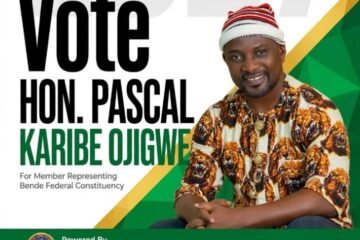
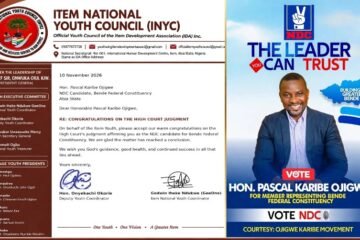
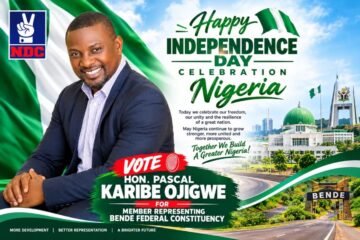
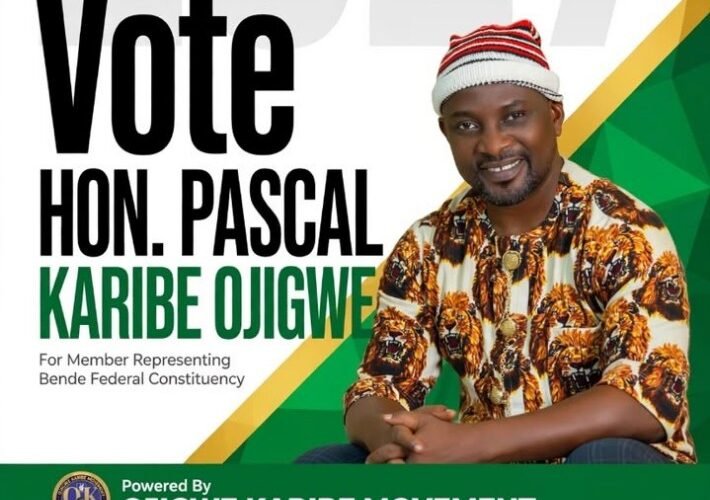
Among the candidates seeking to represent Bende Federal Constituency in 2027 is Hon. Pascal Karibe Ojigwe, the Nigeria Democratic Congress (NDC) candidate.
His aspiration has brought renewed conversations around leadership, experience, youth development, economic empowerment and the future of Bende.
A former international footballer and former Commissioner for Sports in Abia State, Ojigwe brings a background in sports and public service to his political ambition.
His campaign has placed considerable emphasis on peace, prosperity, grassroots development and people-centred representation.
His proposed development priorities include improving infrastructure, facilitating opportunities for young people and women, supporting agriculture, strengthening educational and healthcare facilities, and promoting regular engagement between elected representatives and constituents.
These are important issues that deserve serious public discussion, scrutiny and measurable commitments.
Imagine a Bende where our graduates do not have to leave their communities in desperation to search for opportunities.
Imagine a Bende where farmers can transport their agricultural produce without struggling through deplorable roads.
Imagine a Bende where market women have access to affordable financing, where artisans can develop their skills and where young entrepreneurs can access opportunities to grow their businesses.
Imagine a Bende where our children enjoy quality education, our elderly receive adequate attention and our communities have functional healthcare facilities.
This is the kind of future our people should demand from every political aspirant.
Development must not be concentrated in a few communities. Every part of Bende deserves attention.
One of the greatest challenges facing many communities is the tendency to allow political differences to destroy longstanding relationships.
Bende must rise above this.
Whether you belongs to the APC, PDP, Labour Party, APGA, NDC or any other political platform, our common identity as Ndi Bende should remain important.
Political competition should never become an excuse for hostility, division or disrespect.
We can disagree politically and still remain brothers and sisters.
We can support different candidates and still work together for the development of our homeland.
The Bende of tomorrow must be built on unity, mutual respect and collective responsibility.
The people’s vote is a powerful democratic instrument. It should never be surrendered to sentiment, intimidation, temporary gratification or political propaganda.
Every voter deserves to examine the candidates, understand their programmes, evaluate their capacity and demand clear commitments.
The 2027 election should be about ideas, competence, integrity, accountability and the future of our children.
Ndi Bende must ask important questions:
Who understands our challenges?
Who has a practical development agenda?
Who can effectively represent our interests at the National Assembly?
Who is prepared to remain accessible and accountable?
Who can bring communities together rather than divide them?
These questions should guide our political conversations.
The future of Bende cannot be built by political officeholders alone. It requires the participation of our traditional rulers, community leaders, professionals, business owners, women, youths and the entire electorate.
We must encourage peaceful political participation, protect our democratic values and insist that whoever eventually receives the people’s mandate treats it as a sacred responsibility.
Hon. Pascal Karibe Ojigwe’s aspiration provides another opportunity for Ndi Bende to examine the possibilities before them and engage seriously with the issues that matter.
The ultimate responsibility rests with the electorate.
Let us refuse to surrender our future to political bitterness. Let us refuse to allow temporary divisions to destroy our collective aspirations.
Let us demand a Bende where opportunities are accessible, development is inclusive and leadership is accountable.
A new Bende is possible when the people become united in purpose, courageous in their expectations and determined to demand responsible leadership.
The future is not something we should merely hope for. It is something we must collectively work towards.
KA BENDE GA N’IHU!
A NEW BENDE IS POSSIBLE!